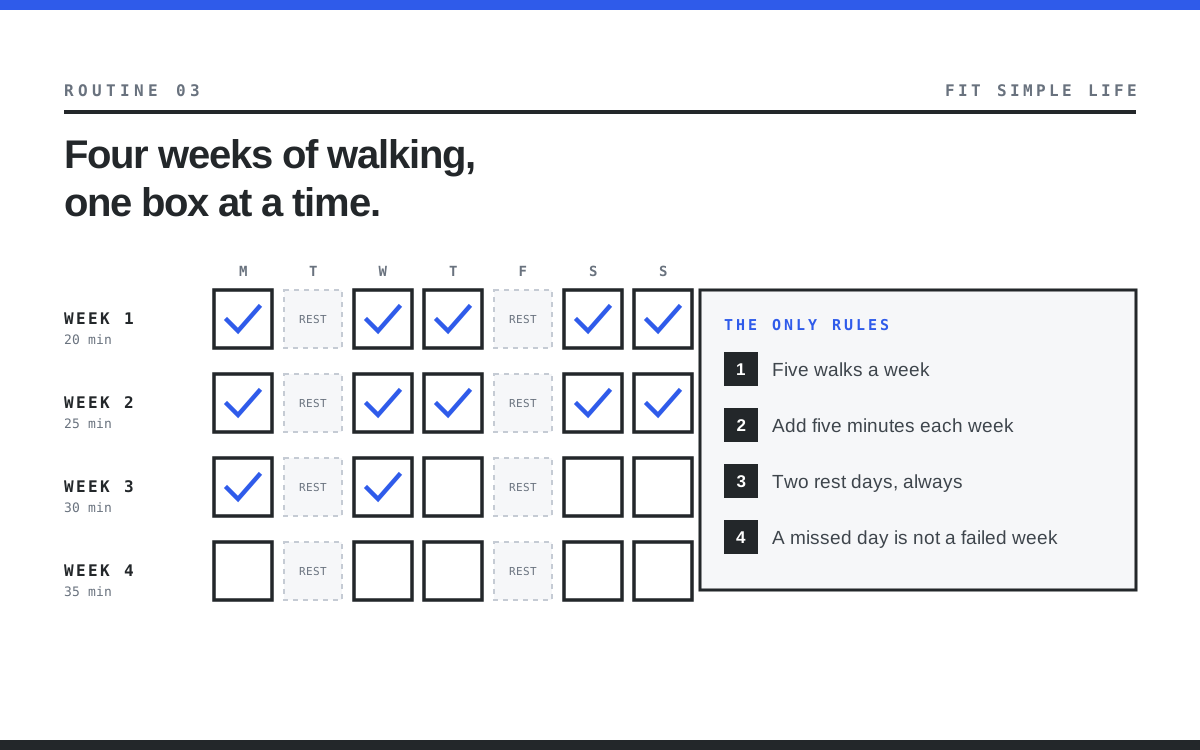
If you want one thing to do for the aerobic half of the guidelines, walk. This plan is five walks a week, starting at twenty minutes and adding five minutes each week, with two rest days you keep no matter what. By week three you are at 150 minutes, the figure the U.S. guidelines use, and by week four you are a little past it. There is no pace target beyond a sentence you can say out loud, and no gear beyond shoes.
Where the 150 minutes comes from
The Physical Activity Guidelines for Americans (second edition) say that "for substantial health benefits, adults should do at least 150 minutes (2 hours and 30 minutes) to 300 minutes (5 hours) a week of moderate-intensity, or 75 minutes (1 hour and 15 minutes) to 150 minutes (2 hours and 30 minutes) a week of vigorous-intensity aerobic physical activity," and that "preferably, aerobic activity should be spread throughout the week." The CDC turns the same figure into the example most people have heard: 30 minutes a day, 5 days a week, of something like brisk walking, which it defines as 2.5 miles per hour or faster.
The less-quoted lines in the same document are the ones that make a plan like this work. "Some physical activity is better than none," the guidelines say, and adults "who sit less and do any amount of moderate-to-vigorous physical activity gain some health benefits." The second edition also dropped the earlier rule that only bouts of ten minutes or longer counted, so a 20-minute walk in week one counts in full, and so would two 10-minute walks on a day when that is all the calendar allows.
The arithmetic of the plan against that figure: week one is five walks of 20 minutes, 100 minutes. Week two is 125. Week three is 150, the guideline. Week four is 175. The guidelines' other line, muscle-strengthening work on two or more days a week, is not covered by walking; that is what our 20-minute routine is for, and the two fit in the same week without competing.
Walking at a pace where you can talk but could not sing is moderate intensity by the CDC's own test. That is the entire pace instruction for this plan. No heart-rate zone, no app, no watch required.
The plan, week by week
Five walks, two rest days, and one number that changes. On the cover the rest days are drawn on Tuesday and Friday; pick any two that suit your week and then keep them fixed, because a rest day you move around is a rest day that turns into three.
Week 1: find the pace 5 × 20 min
Walk 20 minutes at a pace where you could hold a conversation but would rather not sing. Do not chase distance; the point this week is to find a route that starts at your own door and to learn what "talk but not sing" feels like in your legs. Take the first three minutes easy and the last two easy. Tick the box when you get back, on paper or on the phone, but tick it.
Week 2: same route, five more minutes 5 × 25 min
Add five minutes to each walk, not one longer walk to make up the difference. The simplest way is a small extra loop at the end of the route you already know. Check the talk test in the middle ten minutes, which is where people drift into a stroll. Two rest days, same days as last week.
Week 3: the guideline week 5 × 30 min
Five walks of 30 minutes is 150 minutes, the figure the guidelines use. Keep the same pace: the middle twenty minutes at talk-not-sing, the first and last five easier. If your route has a hill, take it once this week and notice the difference in breathing, then go back to the flat version. Nothing else changes.
Week 4: a little past it 5 × 35 min
Five walks of 35 minutes is 175 minutes. If week three felt like plenty, repeat week three instead; the plan has no deadline and repeating a week is a decision, not a failure. At the end of week four, choose one of two things: hold at five walks of 35 minutes, or trade two of the walks for the 20-minute routine so the week has both halves of the guidelines in it.
Pace, steps, and what the research modestly says
The CDC's talk test is the only pace tool the plan needs: "a person doing moderate-intensity aerobic activity can talk, but not sing, during the activity," while someone at vigorous intensity "cannot say more than a few words without pausing for a breath." Brisk, in the CDC's examples, is 2.5 miles per hour or faster, which is a mile in about 24 minutes, but we would rather you never measure it. The sentence test is enough, and it adjusts itself on the days you are tired.
You will see step targets everywhere. The plan is in minutes because minutes are what the guidelines count, and because a phone in a pocket counts steps unevenly. For what it is worth, a 2022 pooled analysis of 15 cohort studies covering 47,471 adults found that all-cause mortality over the follow-up period was progressively lower with more daily steps, up to about 8,000 to 10,000 steps a day for adults younger than 60 and about 6,000 to 8,000 for adults 60 and older, with no further change beyond that. Those are observational associations in people already walking varying amounts, not a target from a trial, and they are not something we set. The honest reading is that ordinary amounts of walking are where the association is strongest, and that more is not endlessly better, which is also why this plan stops at 35 minutes.
Hills, speed and longer walks are all fine later. For these four weeks, the only progression is the five minutes, because a plan with one dial is a plan you can actually follow.
The rules that make it keepable
Five walks a week. Five more minutes each week, never more, even when week two feels easy. Two rest days, always; rest is part of the plan, not a lapse in it. And the rule that matters most: a missed day is not a failed week. If you miss Wednesday, walk Thursday at Thursday's length and carry on. Do not stack two walks into one to catch up, and do not push a rest day out to make room. If you miss three walks in the same week, repeat that week rather than moving on.
The rest is logistics. Walk at the same time each day where you can, because deciding when is the part that gets skipped. Have a wet-weather version: laps of a mall, a treadmill, even laps of the house and stairs count, since the guidelines no longer care about bout length. In heat, walk early or late. And keep the whole thing visible: the cover of this article prints as a grid of boxes for a reason.
- Shoes you can walk 35 minutes in without thinking about them. Nothing new for the plan; the pair you already trust.
- A route that starts at your own door, plus the wet-weather alternative decided in advance.
- Water afterward. For a 20 to 35 minute walk in ordinary weather, plain water is enough; our hydration article covers the long, hot or sweaty sessions where sodium actually matters.
- A calendar or a printed copy of the cover grid, and a pen. Ticking the box is not decoration; it is the mechanism.
- A layer you can take off after the first five minutes.
- Optional: a floor mat for a two-minute calf and hip stretch when you get back. Our recovery routine has the sequence.
This plan is written for a healthy adult who already moves a little. If you are new to exercise, pregnant or recently postpartum, managing a health condition, or taking medication, ask a clinician before starting, and follow their advice over ours. Stop and seek help if you feel chest discomfort, unusual breathlessness, or dizziness. It is not a rehabilitation program, it is not a substitute for the strength days in the guidelines, and in serious heat or ice the right walk is the indoor one.
Sources
- U.S. Department of Health and Human Services, Office of Disease Prevention and Health Promotion. Physical Activity Guidelines for Americans, second edition: executive summary, including the key guidelines for adults (150 to 300 minutes of moderate-intensity aerobic activity a week, spread through the week; muscle-strengthening on 2 or more days). 2018. odphp.health.gov (PDF)
- Office of Disease Prevention and Health Promotion. Top ten things to know about the second edition, including that any amount of activity has some benefit and that the ten-minute-bout requirement was removed. odphp.health.gov
- Centers for Disease Control and Prevention. Adult activity: an overview (150 minutes a week of moderate activity such as brisk walking, for example 30 minutes a day on 5 days; muscle-strengthening on 2 days). cdc.gov
- Centers for Disease Control and Prevention. Measuring physical activity intensity: the talk test, and brisk walking at 2.5 miles per hour or faster as a moderate-intensity example. cdc.gov
- Meta-analysis of daily step counts and all-cause mortality across 15 international cohorts (47,471 adults). The Lancet Public Health, 2022. pmc.ncbi.nlm.nih.gov
- American College of Sports Medicine. Position stand on the quantity and quality of exercise for apparently healthy adults (moderate activity 30 minutes a day on 5 or more days; benefit at amounts below the target). Medicine & Science in Sports & Exercise, 2011. pubmed.ncbi.nlm.nih.gov
This article is educational and is not medical advice. Ask a qualified clinician before starting a new exercise or nutrition routine, especially if you have an existing condition or take medication.