Most days, for most people, the answer is water when you are thirsty and a normal amount of salt in your food. An electrolyte stick is a useful thing for a specific situation — a long, hot, sweaty session — and an expensive way to flavor water the rest of the time. Here is how to tell the two situations apart without a lab.
Most days, thirst is the guide
The reference numbers people quote — about 3.7 liters a day of total water for men and 2.7 for women, from the National Academies’ 2005 report on water and electrolytes — include the water in food and in every drink, coffee and tea included. They were never a target for plain water. The same report says that on a day-to-day basis, fluid intake driven by thirst plus what you drink with meals keeps body water at normal levels. Water deficits build up over a few hours of heat or hard activity, not over a normal day at work.
Where thirst falls short is a narrower case than the ads suggest. A 2018 review in Sports Medicine — written by a US Army researcher and published in a supplement funded by a sports-drink maker, which is worth knowing — lays it out. Drinking to thirst is generally sufficient for sessions under about an hour to 90 minutes, in cooler conditions, or at lower intensity. Planned drinking earns its place for longer efforts, particularly in heat, for people with high sweat rates, and when performance matters. The same paper is blunt about the other direction: never drink so much that you finish a session heavier than you started.
For a 30-minute walk or a 20-minute routine at home in ordinary weather, the correct sports drink is a glass of water afterwards, or before if you like. Nothing in the sources we read supports an electrolyte product for a session that short.
When sodium actually matters
Sweat is salty water, and how salty varies a lot. A 2017 review in Sports Medicine of how sweat is measured (its author works at a sports-drink maker’s research institute, which is worth knowing) puts whole-body sweat rates for athletes typically between about 0.5 and 2.0 liters an hour, and whole-body sweat sodium at roughly 10 to 70 millimoles per liter — in plainer units, about 230 to 1,600 mg of sodium per liter of sweat. People adapted to heat lose less salt per liter, and two people doing the same workout in the same room can differ several-fold.
The American College of Sports Medicine’s position stand on fluid replacement is the standard reference, and its points are simple. Start a session normally hydrated. During it, the aim is to avoid what the ACSM calls excessive dehydration — a body-mass deficit of more than about 2 percent — and big swings in electrolytes. Sweat rate and sweat salt vary so much between people that a one-size plan does not work, and the simplest way to learn your own number is to weigh yourself before a session and again afterwards. Drinks with electrolytes and carbohydrate “can provide benefits over water alone under certain circumstances.” Afterwards, replace what you lost; how aggressively depends on how much you lost and how soon you need it back. Each pound you are down on the scale after a session is roughly 15 fluid ounces of sweat that went out and did not come back in.
Put those together and the case for sodium is: sessions long enough (an hour and a half is a reasonable line), hot enough, or sweaty enough that you are losing a liter or more of salty sweat, especially on back-to-back days. A 60-minute gym session in an air-conditioned room, a 35-minute walk in April, or a day at a desk is not that.
For scale: the FDA’s Daily Value for sodium is less than 2,300 mg a day, and Americans eat about 3,400 mg on average. Most of us are not short of salt at rest, and the sodium in a normal meal after a normal session covers a normal session.
Reading a stick in ten seconds
Every electrolyte stick carries a Nutrition Facts or Supplement Facts panel. Three numbers do the work: sodium (mg), sugar (g), and the volume of water the serving is meant to go in. Potassium is a distant fourth. Everything on the front of the pack is design.
A worked example, from the label of the product on our Fuel list: Liquid I.V. Hydration Multiplier, Lemon Lime. One stick (16 g), mixed into 16 oz of water per the pack directions, is 50 calories, 500 mg of sodium (22% of the Daily Value), 11 g of carbohydrate, every gram of which is added sugar (22% DV), 370 mg of potassium (8% DV), 62 mg of vitamin C, and four B vitamins at or above 100% DV. (The label image on the Amazon listing prints 45 calories for the same panel; every other line matches.) The ingredient statement on the Amazon listing (read September 30, 2026) begins with pure cane sugar, dextrose, citric acid and salt. The brand’s own explainer page states the electrolyte amounts the same way: about 870 mg per serving, of which roughly 500 mg is sodium and 370 mg potassium.
What the arithmetic means: 500 mg in 16 oz is about 1,050 mg per liter, which sits in the middle-to-upper part of the sweat-sodium range above. That is what you would want if you are replacing salty sweat, and more than you need if you are not sweating. The sugar works out to about 2.3 g per 100 mL, a light drink by sports-drink standards — the ISSN nutrient-timing position stand describes 6 to 8 percent carbohydrate solutions for fueling hard efforts beyond an hour — so a stick is a salt-and-water product with a little sugar, not a fuel product. It is still 11 g of added sugar, about what is in a tablespoon of table sugar.
- Sodium in mg per serving — then divide by the water volume to compare products fairly.
- Sugar in g — decide whether you want it. Some sugar is doing a job (next section); it is still sugar.
- Serving volume — 8 oz versus 16 oz changes every comparison.
- Potassium — nice to have, small.
- Price per stick, with the date you saw it — on the product page, not here; it moves.
- Whether you would drink it if there were no ad — the cheapest test on the list.
Why “IV-level hydration” is not a thing
An IV drip puts fluid straight into a vein. A drink goes into your stomach and then your small intestine, where the water crosses into the blood. No powder changes that route. Whatever a brand name or a front-of-pack line implies, the label describes a powder you stir into 16 oz of water and swallow.
There is a real piece of science underneath the marketing, and it is old and unglamorous: sodium and glucose together are taken up by the small intestine in a way that pulls water along with them. That is the principle behind oral rehydration salts, which the World Health Organization describes as a glucose-electrolyte solution given by mouth for a specific medical situation, and it is why these sticks contain sugar and salt rather than salt alone. The brand’s own explainer describes the mechanism in the same plain terms — sodium helps water and glucose cross the intestinal wall. That is a reasonable thing to want after a long, hot session. It does not make the stick an intravenous anything.
The comparative lines on the pack and the listing — “hydration faster than water alone,” “3x the electrolytes of the leading sports drink” — are the brand’s claims. We have no way to test speed at home, and the leading sports drink is not named on the pack, so we do not repeat those claims as facts. We read the label, and the label describes a decent product for the situation it fits.
A workout-day drinking routine
Three steps by the clock. It is the same on a walk day as on a gym day; only the session length changes what step 2 looks like.
Before 2–4 h
Drink normally with your last meal before the session — a glass of water, or whatever you usually have. The ACSM’s point is to begin normally hydrated, not to preload. If you are drinking so much beforehand that you keep running to the bathroom, that is too much, not too little.
During sip to thirst
Under an hour in ordinary weather: sip to thirst; a bottle nearby is enough. Over about 90 minutes, or hot, or if you are a heavy sweater: plan sips every 15 to 20 minutes rather than waiting for thirst, and this is the one situation where a stick in the bottle is a reasonable choice. Never drink so much that you gain weight during a session.
After within 2 h
Drink to thirst and eat a normal, salted meal. If you want your own number, weigh yourself once before a long session and again afterwards: each pound down is about 15 fluid ounces of sweat. If that number is large and you are training again tomorrow, replacing it with something salty — food or a stick — is sensible. If it is small, you are done. The rest of the after-session sequence is in our recovery routine.
When a stick earns a place, and when it does not
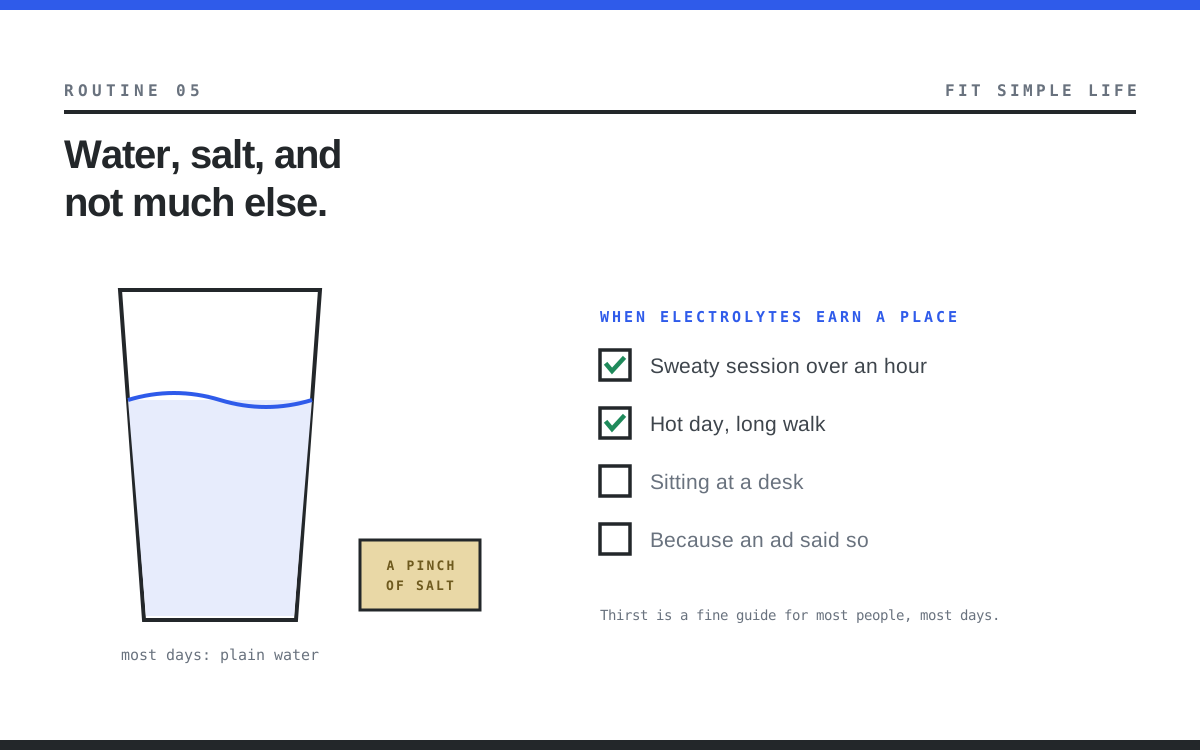
The same list that is on the cover, spelled out.
- Yes: a sweaty session over about 90 minutes, or over an hour in real heat.
- Yes: a long walk or hike on a hot day, especially on back-to-back days. Weeks 3 and 4 of the walking plan in July might qualify; week 1 in October does not.
- Yes: after a session where the scale showed a pound or two of sweat you did not drink back, and you are training again tomorrow.
- No: a desk day, a short walk, or a 20-minute routine at home in ordinary weather.
- No: because the packaging says so. If plain water bores you, a squeeze of lemon is cheaper and has no sodium to think about.
If a clinician has ever asked you to limit fluids or sodium, or you take a diuretic or any medication that affects your kidneys or fluid balance, ask them before adding an electrolyte product: 500 mg of sodium is a meaningful share of a restricted day. If you are pregnant or managing any existing condition, same answer. In the other direction, drinking plain water far beyond thirst for hours, especially during long events, can dilute blood sodium to a dangerous level; the “never gain weight during a session” rule is the simple guard. This article is educational, not a hydration prescription.
Sources
- National Academies (Institute of Medicine). Dietary Reference Intakes report on water and electrolytes, chapter on water: Adequate Intakes and the role of thirst. National Academies Press, 2005. link
- US Army Research Institute of Environmental Medicine author. Review of planned drinking versus drinking to thirst (published in a Gatorade Sports Science Institute-supported supplement). Sports Medicine, 2018. link
- American College of Sports Medicine. Position stand on exercise and fluid replacement. Medicine & Science in Sports & Exercise, 2007. link
- Review of sweat-rate and sweat-sodium measurement and variability in athletes (author affiliated with the Gatorade Sports Science Institute). Sports Medicine, 2017. link
- U.S. Food and Drug Administration. Sodium in your diet: the Daily Value and average American intake. link
- World Health Organization and UNICEF. Guidance document on production of the reformulated oral rehydration salts, which describes ORS as a glucose-electrolyte solution given by mouth. 2006. link
- International Society of Sports Nutrition. Position stand on nutrient timing, including carbohydrate-electrolyte solutions during long exercise. Journal of the International Society of Sports Nutrition, 2017. link
- Liquid I.V. Lemon Lime Hydration Multiplier product page (claims as worded by the brand) and the Nutrition Facts label image on the brand’s shop page, both read September 30, 2026. product page, shop page with label
- Liquid I.V. Brand explainer on tonicity, stating per-serving sodium and potassium and the sodium-absorption mechanism. Read September 30, 2026. link
This article is educational and is not medical advice. Ask a qualified clinician before starting a new exercise or nutrition routine, especially if you have an existing condition or take medication.