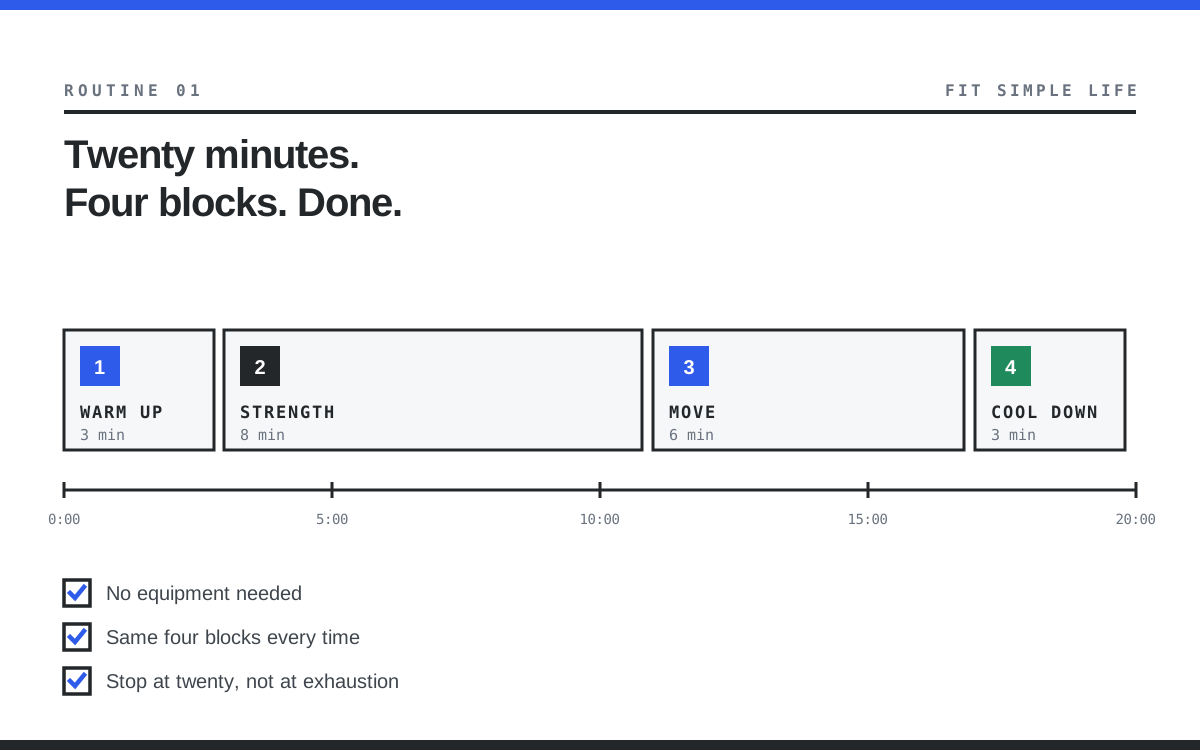
The question most people actually have is not "what is the best workout" but "what is the smallest workout I will still be doing in March." This is our answer: twenty minutes, four blocks, the same shape every time, on three to five days a week. It is deliberately unimpressive. That is why it survives contact with a normal week, a normal job and a normal amount of enthusiasm.
Why twenty minutes, and why it counts
The U.S. Physical Activity Guidelines (second edition) ask adults for 150 to 300 minutes a week of moderate-intensity aerobic activity, or 75 to 150 minutes of vigorous activity, plus muscle-strengthening work "that involve[s] all major muscle groups on 2 or more days a week." That is the official target, and it is also the sentence that stops people, because 150 minutes sounds like a second job.
Two things in the same document make it less intimidating. First, the guidelines say plainly that "some physical activity is better than none" and that adults "who sit less and do any amount of moderate-to-vigorous physical activity gain some health benefits." Second, the second edition dropped the old rule that only bouts of ten minutes or longer counted toward the total; any length now counts. The American College of Sports Medicine's position stand on exercise for healthy adults says the same thing in its own words: adults who are "unable or unwilling to meet the exercise targets" still benefit from doing less than the recommended amount.
So the arithmetic is honest rather than heroic. Five sessions of this routine is 100 minutes of activity, though only the six-minute move block is aerobic in the guidelines' sense. The strength block on its own satisfies the "2 or more days" muscle-strengthening line, and the move block contributes to the aerobic minutes. Pair it with our four-week walking plan and you are past 150 minutes without either piece feeling like a project. Even three sessions a week is 60 minutes and still covers the two strength days. Our position is simple: a session you do forty weeks a year beats a session you do for three weeks in January.
Twenty is a cap, not a floor. The routine ends at 20:00 on the timer whether or not you feel finished. The habit you are building is showing up, and the session that ends while you could have done more is the one you come back to tomorrow.
The routine, block by block
Set a timer for twenty minutes and run the four blocks in order. Everything below is bodyweight; the two moves that use a band have a no-band version.
Warm up 3 min
One minute of easy marching in place, or a walk to the end of the hall and back with your arms swinging. One minute of slow circles: ankles, hips and shoulders, ten each way. One minute of the strength moves at half effort: five slow chair squats, five push-ups against the kitchen counter, five hip hinges with your hands on your thighs. A 2010 systematic review of 32 studies found a warm-up improved performance in 79% of the measures examined; the review did not put a single size on that gain, and starting slowly is also simply more pleasant than starting cold.
Strength 8 min
Four moves, two rounds. Work each move for about 45 seconds at a controlled pace, take 15 seconds to move to the next, and one round is four minutes. (1) Chair squat: stand in front of a sturdy chair, sit back until you touch it, stand up. (2) Push-up at whatever height lets you do 8 to 12 clean reps: hands on the counter, then a low bench, then the floor. (3) Row: loop a resistance band around a post or under both feet and pull your elbows back and past your ribs; without a band, hold a full water jug in each hand, hinge at the hips and row. (4) Glute bridge: on your back, knees bent, push your hips up, pause, lower. Stop a move when the reps get sloppy, not when the timer forces you. Between them, the four moves cover legs, pushing, pulling and hips, which is what "all major muscle groups" means in practice.
Move 6 min
Six minutes of continuous movement at a pace where you can talk but could not sing, which is the CDC's own description of moderate intensity. Rotate one minute each: march or jog in place; step-ups on the bottom stair, switching the lead leg every 30 seconds; side steps across the room, with the band around your ankles if you have one; then repeat. If you have a block outside your door that takes six minutes, a brisk walk around it is the same block. The goal is breathing harder, not gasping.
Cool down 3 min
One minute of slow walking until your breathing settles. Then three stretches, 30 seconds each: calves with your hands on a wall, a standing quad stretch holding a chair, and chest in a doorway. The ACSM position stand suggests flexibility work at least two days a week, with about 60 seconds of total hold per exercise, so this is a half-dose that fits. An honest note: a 2018 narrative review found that most evidence indicates active cool-downs do not significantly reduce muscle soreness. What a gentle finish may do, per the same review, is help heart rate and breathing settle a little sooner, and it marks a clean end to the session, and for most people this is the only three minutes of stretching in their week. We keep it for those reasons, not for magic ones.
How to keep it, and how to make it harder without making it longer
The routine is not the part that fails. The calendar is. Anchor the session to something that already happens every day: while the kettle boils, before the shower, straight after the school run. Same time, same patch of floor, timer where you can see it. Deciding when every day is the tax that kills most home routines; pay it once.
When it gets easy, change one thing, and never the length. The dials, in order: first, more reps inside the same 45 seconds with the same form; second, more range, meaning a deeper squat or a lower push-up surface; third, a heavier band color for the row and the side steps; fourth, once the bodyweight versions are boring, swap the chair squat for a goblet squat holding a single kettlebell at your chest, and the bridge for a kettlebell hinge. Our kettlebell entry covers how to choose a starting weight honestly. A slower lowering phase, three seconds down on every rep, is a free way to make any of the four moves harder before you buy anything.
Have a three-day floor for bad weeks. If the week collapses, do Monday, Wednesday and Friday and call it done; the strength block still gets you the two-day line in the guidelines. Miss a day? Do the next scheduled session at the scheduled length. Do not stack two sessions to catch up; the cap is the cap.
And when the routine stops feeling like anything, that is not a signal to add ten minutes. It is the point at which it has become a habit, which was the goal. Add a walk on the other days instead, or use the off-days for our simple recovery routine.
What you need
Almost nothing, which is the point. Here is the honest list, including the optional parts.
- About two by one meters of floor and a sturdy chair that does not slide.
- A timer you can see. A phone on airplane mode works; the point is not to look at anything else for twenty minutes.
- Optional: a set of loop resistance bands. Five resistance levels in one small bag, used here for the row and the side steps, and the cheapest useful upgrade on this site.
- Optional: a floor mat for the bridge and for floor push-ups on a hard surface. A folded towel does the same job less comfortably.
- Optional, later: a single cast iron kettlebell for when you want the strength block to feel like something again.
- Shoes or bare feet, whichever you would walk around the house in. Nothing on this list needs to be bought before you start tomorrow.
This routine is written for a healthy adult who already moves a little. If you are new to exercise, pregnant or recently postpartum, managing a health condition, or taking medication, ask a clinician before starting. Stop if you feel chest discomfort, dizziness, or sharp joint pain; normal muscle effort feels like effort, not pain. This is not a rehabilitation program, and on its own it does not deliver all the aerobic minutes in the guidelines; the walking plan is the other half.
Sources
- U.S. Department of Health and Human Services, Office of Disease Prevention and Health Promotion. Physical Activity Guidelines for Americans, second edition: executive summary, including the key guidelines for adults (150 to 300 minutes of moderate-intensity aerobic activity a week; muscle-strengthening on 2 or more days). 2018. odphp.health.gov (PDF)
- Office of Disease Prevention and Health Promotion. Top ten things to know about the second edition of the guidelines, including the removal of the ten-minute-bout requirement. odphp.health.gov
- American College of Sports Medicine. Position stand on the quantity and quality of exercise for developing and maintaining fitness in apparently healthy adults (aerobic, resistance, flexibility and neuromotor guidance). Medicine & Science in Sports & Exercise, 2011. pubmed.ncbi.nlm.nih.gov
- Centers for Disease Control and Prevention. Measuring physical activity intensity: the talk test and examples of moderate-intensity activity. cdc.gov
- Systematic review with meta-analysis of the effect of warming up on physical performance (32 studies). Journal of Strength and Conditioning Research, 2010. pubmed.ncbi.nlm.nih.gov
- Narrative review asking whether an active cool-down is needed after exercise, covering soreness, next-day performance and recovery. Sports Medicine, 2018. pmc.ncbi.nlm.nih.gov
This article is educational and is not medical advice. Ask a qualified clinician before starting a new exercise or nutrition routine, especially if you have an existing condition or take medication.