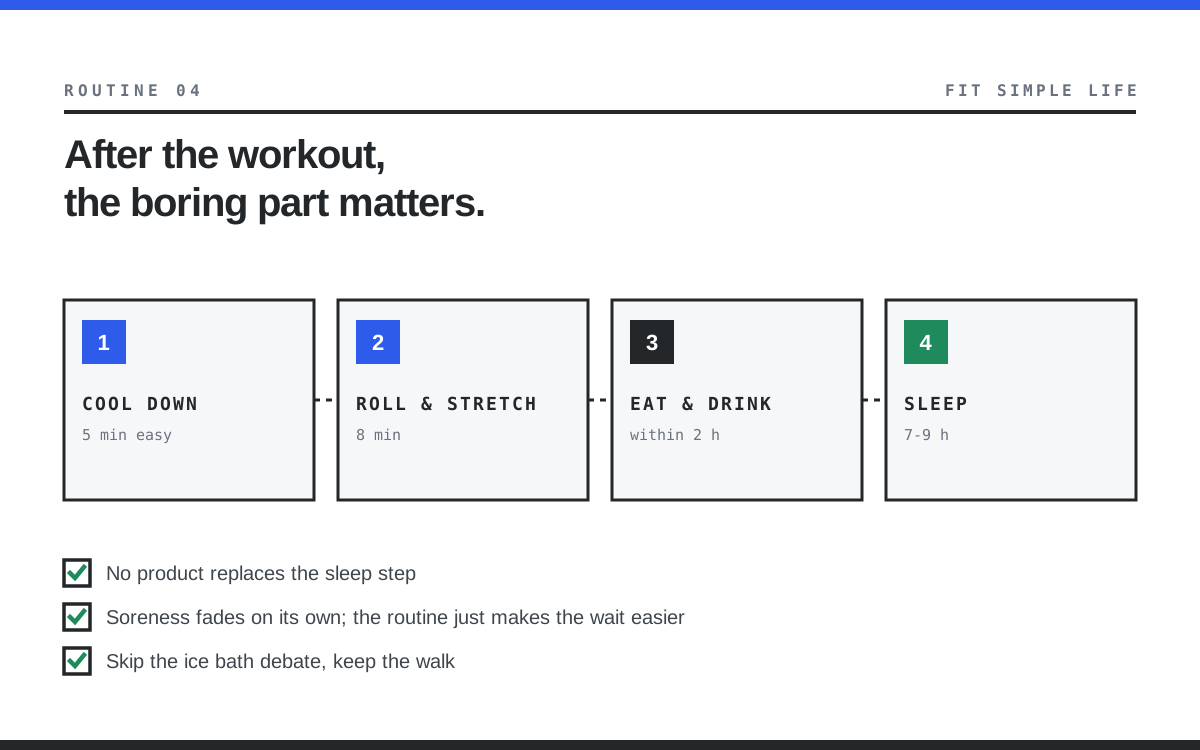
The honest answer to “what should I do after a workout?” is: not much, and the same not-much every time. Walk for a few minutes, spend a few more on the floor with a roller if you like it, eat a normal meal within a couple of hours, and go to bed on time. That is the whole routine. Everything else sold under the word “recovery” is either a small extra or a story.
What next-day soreness actually is
The stiff, tender feeling that shows up a day or two after a session you were not used to has a plain name: delayed-onset muscle soreness, usually shortened to DOMS. A 2003 review in Sports Medicine describes it as most common at the start of a season or whenever someone tries a new kind of movement, and notes it tends to be worse after “eccentric” work — the lowering half of a squat, walking downhill, the slow part of a push-up — than after other kinds of effort. The intensity and length of the session matter too.
Lactic acid is the popular explanation, but it is only one of six hypotheses the same review lists (the others include muscle and connective-tissue damage and inflammation), and the authors’ reading is that a combination of two or more of them likely explains the soreness, not any single cause. A 2025 study that measured calf-muscle stiffness day by day after a fatigue protocol found the peak of soreness at about 48 hours, then a fade. In practice: it arrives late, peaks on the second day, and leaves on its own.
Two more useful facts from the 2003 review. First, the most effective way to ease the ache while you have it is gentle movement, although the relief is temporary. Second, if you train on consecutive days, the sensible move after a session that produced heavy soreness is to go lighter for a day or two rather than to stop, and to work other areas meanwhile. New or eccentric-heavy movements introduced gradually over one to two weeks produce less of it.
Soreness is a sign you did something new, not a sign you did something wrong — and not proof you did something right, either. It fades whether or not you buy anything. The routine below makes the two days easier; it does not shorten them by much.
What rolling, massage guns and stretching actually do
Foam rolling. A 2019 meta-analysis of 21 studies in Frontiers in Physiology compared rolling done as a warm-up with rolling done after a session. Rolling afterwards reduced how sore people said they were by about 6 percent and slightly softened the post-exercise dip in sprint and strength performance (roughly 3 to 4 percent). The authors’ summary was that the effects are “rather minor and partly negligible,” and that the better case for a roller is as part of a warm-up, where it produced a small flexibility gain.
Massage guns. A 2023 systematic review found only 11 usable studies, ten of them at moderate risk of bias. The consistent findings were short-term gains in range of motion and flexibility and some recovery-related measures after a fatigue protocol; using one right before strength, balance or explosive work either did nothing or reduced performance. The 2025 study above put foam rolling and a percussion device head to head for three days after a calf-fatigue protocol: both were credited with faster recovery of muscle tone and stiffness than passive rest, with foam rolling the clearer of the two, and neither beat plain rest for pain.
Hands-on massage. In a 2018 meta-analysis of 99 studies, massage came out as the most effective single technique for soreness and perceived fatigue, with active recovery, compression garments, water immersion and cold exposure also producing small-to-large reductions. A roller or a gun is a cheap, imperfect stand-in for a person’s hands. That is the honest framing for both.
Stretching. A Cochrane review of 12 studies found that stretching after exercise reduced next-day soreness by, on average, about one point on a 100-point scale, an estimate so uncertain it could equally be zero; in the one large trial, stretching on both sides of an exercise session trimmed peak soreness over a week by about four points, an effect the authors described as statistically significant but very small. Their conclusion was that stretching before, after, or both “does not produce clinically important reductions” in this kind of soreness in healthy adults. Stretch because it feels good and you want the range of motion, not to dodge soreness.
Cool-downs. A 2018 narrative review concluded that an active cool-down is “largely ineffective” for same-day and next-day performance, and that most evidence shows it does not significantly reduce muscle soreness either. What it does do is clear lactate from the blood faster, and it may help heart rate and breathing settle sooner. We keep it in the routine because a five-minute walk is a pleasant, no-cost way to end a session, not because it fixes anything.
Ice baths. Cold-water immersion shows up in the 2018 meta-analysis as one of the techniques with a measurable effect on soreness. It is also cold, wet and easy to overdo. For a normal person on a normal week, the walk is enough. We are not against a cold shower; we are against buying a tub for it.
The routine: four steps, about fifteen minutes plus a night’s sleep
Run this after every session, in order. The times are guides, not rules.
Cool down 5 min
Keep moving at a pace where you could talk in full sentences: a walk around the block, a slow spin on the bike, easy laps. Stop when your breathing is back to normal. That is the whole cool-down. If you are short on time, this is the step to trim — not the sleep.
Roll and stretch 8 min
On the floor with a roller: 30 to 60 seconds on each big area you used — calves, hamstrings, quads, upper back — with some of your weight on your hands so the pressure is firm but not wince-level. A massage gun does the same job standing up; keep it off bony spots and the front of the neck, and use the lowest speed that does not feel like nothing. Then two or three easy stretches for whatever feels tight, held 20 to 30 seconds, no bouncing. Expect it to feel good and to change your next-day soreness only slightly.
Eat and drink within 2 h
A normal meal with a real protein portion. The ISSN position stand on nutrient timing supports 20 to 40 g of a good-quality protein in the window from right after a session to about two hours later, and notes that hitting your total for the day, spread across meals, matters more than the clock. Add a carbohydrate portion if the session was long or hard. Drink to thirst; most sessions under an hour need water and nothing else (see our hydration article for the exceptions, and protein basics for the food side).
Sleep 7+ h
The joint consensus of the American Academy of Sleep Medicine and the Sleep Research Society is seven or more hours per night on a regular basis for adults. The CDC repeats that figure and adds a short list of habits: the same bedtime and wake time every day, a quiet, relaxing room kept cool, electronic devices off at least 30 minutes before bed, no big meals or alcohol close to bedtime, and no caffeine in the afternoon or evening. None of it is exotic. It is the one step no product replaces.
The day after, when it hurts
Soreness peaks around the second day. Here is what to do with it.
- Move gently. Per the 2003 review, easy exercise is the most reliable short-term reliever, even though the relief wears off. A walk, or the warm-up block of the 20-minute routine at half effort, is plenty.
- Go lighter for a day or two rather than skipping the week. The same review suggests reducing intensity and duration for one or two days after a session that produced heavy soreness, or working the areas that are not sore.
- Introduce new movements gradually over one to two weeks. The soreness from the first session of something new is the biggest you will get from it.
- Know the difference. A dull, even, “I used those muscles” ache that eases as you warm up is soreness. Sharp pain, pain inside a joint, swelling, pain on one side only, or pain that gets worse over several days is not — stop and ask a clinician.
What you need (and what is optional)
Nothing on this list is required. Sleep, a meal and a walk do most of the work.
- A floor and a few square feet of space.
- Optional: a foam roller. We looked at the TriggerPoint GRID on its build, size and price; the evidence above applies to any roller, cheap or not.
- Optional: a percussion massager. Our RENPHO Active page reads the spec sheet (stall force, amplitude, battery, noise) against the same modest evidence.
- Optional: a plain magnesium capsule. Recovery aisles are full of them, usually marketed around “muscle” and “sleep.” Those are the sellers’ words, not ours. The adult RDA is 310 to 420 mg a day depending on age and sex, and most people get most of it from food; our Nature Made magnesium glycinate page reads the label against the NIH numbers, neutrally.
- Water, and a meal you were going to eat anyway.
This routine assumes a healthy adult who already moves a little. If you are new to exercise, have an existing condition, take medication or are pregnant, ask a clinician before adding rolling or a massage device, and keep both off bruises, a recent injury, swelling, or anywhere that feels numb. Stop any step that produces sharp pain. Nothing here diagnoses anything: if your soreness does not follow the “arrives late, peaks on day two, fades” pattern, that is a question for a clinician, not for a roller.
Sources
- Auckland University of Technology authors. Review of delayed-onset muscle soreness: what causes it, when it peaks, and how it is managed. Sports Medicine, 2003. link
- Ruhr University Bochum and co-authors. Meta-analysis of 21 studies on foam rolling as a warm-up and as a recovery tool. Frontiers in Physiology, 2019. link
- Polytechnic Institute of Maia and co-authors. Systematic review of 11 massage-gun studies on performance and recovery. Journal of Functional Morphology and Kinesiology, 2023. link
- Warsaw Medical Academy of Applied Sciences and co-authors. Foam rolling versus percussive massage versus rest for three days after a calf-fatigue protocol. Journal of Functional Morphology and Kinesiology, 2025. link
- University of Poitiers. Meta-analysis of 99 studies on post-exercise recovery techniques and soreness, fatigue and inflammation markers. Frontiers in Physiology, 2018. link
- Cochrane. Review of 12 studies on stretching before or after exercise and muscle soreness. Cochrane Database of Systematic Reviews, 2011. link
- Maastricht University and Queensland University of Technology. Narrative review on whether an active cool-down helps recovery. Sports Medicine, 2018. link
- International Society of Sports Nutrition. Position stand on nutrient timing. Journal of the International Society of Sports Nutrition, 2017. link
- American Academy of Sleep Medicine and Sleep Research Society. Joint consensus statement on the recommended amount of sleep for a healthy adult. Sleep, 2015. link
- Centers for Disease Control and Prevention. About sleep: how much adults need and habits for better sleep. link
- MedlinePlus (National Library of Medicine). Magnesium in diet: recommended dietary allowances for adults. Reviewed January 2025. link
This article is educational and is not medical advice. Ask a qualified clinician before starting a new exercise or nutrition routine, especially if you have an existing condition or take medication.