Protein is the one nutrient normal people get shouted at about. The plain version: the official minimum for adults is 0.8 grams per kilogram of body weight per day, active adults are usually pointed toward more than that, and almost all of it can come from ordinary food spread across the day. Everything else is detail. Useful detail, so here it is.
What the RDA is, and what it is not
The Recommended Dietary Allowance for protein comes from the National Academies' 2005 Dietary Reference Intakes report on macronutrients, and it is 0.8 g per kilogram of body weight per day; the International Society of Sports Nutrition's position stand quotes it the same way, "the current RDA for protein is 0.8 g/kg/day." An RDA is the amount estimated to cover the needs of nearly all healthy adults. It is a floor to stay above, not a target tuned for somebody doing a strength routine three times a week.
In pounds, since that is how most of us know our weight: a 150 lb adult is about 68 kg, so the RDA works out to roughly 54 g a day. At 180 lb (about 82 kg) it is roughly 65 g. At 200 lb (about 91 kg) it is roughly 73 g. These are our arithmetic on the published figure, rounded.
Two other numbers you will run into. The Nutrition Facts label calculates its percent Daily Value for protein against a single reference figure of 50 g a day (FDA), which is a labeling convention rather than a personal recommendation. And the MedlinePlus encyclopedia gives the acceptable range for healthy adults as 10% to 35% of total calories. All three agree on the shape of the thing: the minimum is modest and reachable with ordinary meals.
0.8 g/kg is a floor for healthy adults, not a performance target. If you do the 20-minute routine and walk most days, the ranges below are where guidance for active people lands, and they are ranges, because the studies behind them were mostly done on people training harder than you probably are.
The higher ranges for active adults, and where they come from
The ISSN position stand on protein and exercise (2017) says that "an overall daily protein intake in the range of 1.4–2.0 g protein/kg body weight/day (g/kg/d) is sufficient for most exercising individuals" whose goal is building or keeping muscle. Read the qualifier: exercising individuals, meaning people training with muscle as the objective, not someone walking five days a week.
A 2018 meta-analysis in the British Journal of Sports Medicine pooled 49 randomized trials with 1,863 healthy adults who were resistance training and found that adding protein beyond a total intake of about 1.6 g/kg/day "resulted in no further" gains in the study's measure of muscle mass. So the pooled data flatten out around 1.6 for people lifting seriously; more than that did not keep paying.
Put together, that gives a normal active adult a sensible bracket: 0.8 g/kg is the floor, roughly 1.2 to 1.6 g/kg is a sensible middle for a person doing our routines (our reading of the two sources above, not a figure either one sets), and the upper end of the ISSN range is for people training hard with muscle as the goal. In grams, using the same three example weights: at 68 kg, that is about 54 g at the RDA, 82 g at 1.2, and 109 g at 1.6. At 82 kg, about 65, 98 and 131 g. At 91 kg, about 73, 109 and 146 g.
The hedges matter. These ranges come from trials on trained, often young participants over weeks to months; the outcome in many of them is a laboratory proxy, such as the rate of muscle protein synthesis over a day, rather than anything you would notice day to day. Body-weight arithmetic also gets odd at the extremes of weight. A registered dietitian can set an individual number if you want one, and if a clinician has ever told you to watch your protein intake, ask them before changing anything.
What it looks like on a plate
The per-100 g figures below are from USDA FoodData Central (SR Legacy entries; the database ID is in brackets so you can check them). The portion figures are our arithmetic, rounded, so read them as "about."
- Chicken breast, roasted, meat only: 31.0 g per 100 g. A 4 oz (113 g) cooked portion is about 35 g. [171477]
- Light tuna, canned in water, drained: 25.5 g per 100 g. A standard can drained, about 4 oz of fish, is roughly 29 g. [171986]
- Whole eggs: 12.6 g per 100 g. One large egg (about 50 g) is roughly 6 g. [171287]
- Greek yogurt, plain, low-fat: about 10 g per 100 g. A 150 g single-serve cup is about 15 g. [170903]
- Cottage cheese, 2% milkfat: 10.4 g per 100 g. Half a cup (113 g) is about 12 g. [172182]
- Firm tofu (calcium-set): 17.3 g per 100 g. A 100 g slab is about 17 g. [172475]
- Lentils, cooked: 9.0 g per 100 g. A cup (about 200 g) is about 18 g. [172421]
- Black beans, canned (low-sodium entry): 6.0 g per 100 g. A 240 g portion, roughly a cup, is about 14 g. [175238]
- 2% milk: 3.3 g per 100 g. A cup (244 g) is about 8 g. [171267]
- Peanut butter, smooth: 22.2 g per 100 g. Two tablespoons (32 g) is about 7 g. [172470]
The pattern is what matters, not the decimals: animal foods are dense (a palm-sized portion of meat or fish is 25 to 35 g on its own), dairy and eggs are the easy middle, and plant sources need bigger portions or stacking, so a plant-based day usually leans on tofu, lentils and beans together rather than any one of them. Our plant protein powder entry goes into what a blended plant protein does and does not give you.
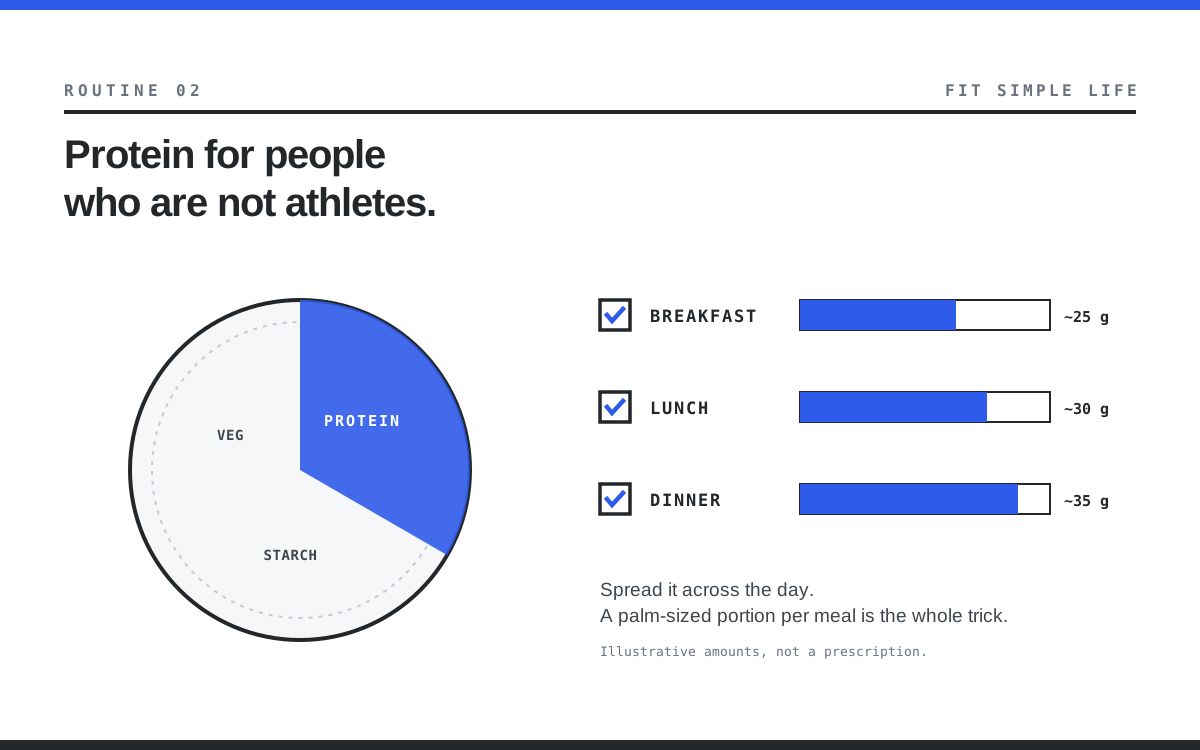
Here is one ordinary day laid out the way the cover shows it. The amounts are illustrative, not a prescription, and the times are just to show the spacing.
Breakfast, about 25 g 7:00 am
Two eggs (about 12 g) with half a cup of cottage cheese (about 12 g), or the same eggs with a single-serve Greek yogurt if you would rather (a little more, about 27 g), plus whatever toast or fruit you were having anyway. Coffee is not breakfast; this takes six minutes.
Lunch, about 30 g 12:30 pm
A drained can of light tuna (about 29 g) over a salad with bread, or a cup of cooked lentils (about 18 g) with a single-serve Greek yogurt on the side (about 15 g) if you would rather not open a can of fish at your desk.
Dinner, about 35 g 7:00 pm
A 4 oz portion of chicken breast (about 35 g) with rice and vegetables; a 100 g slab of firm tofu plus a cup of black beans gets a plant-based dinner to about 30 g.
That day is about 90 g. For an 82 kg adult that is roughly 1.1 g/kg; for a 68 kg adult, roughly 1.3 g/kg. No powder in it, and nothing you would describe as a high-protein diet.
Spread it across the day
The one piece of timing that seems to matter is not the clock but the spread. A small 2014 trial in The Journal of Nutrition gave eight healthy adults the same daily protein two ways: evenly, at about 30 g per meal, or skewed, at roughly 11 g at breakfast, 16 g at lunch and 63 g at dinner. The even pattern produced a 24-hour muscle protein synthesis rate about 25% higher than the skewed one. Eight people and a laboratory measure is a small study, so hold it loosely, but it points the same direction as the ISSN guidance: aim for about 0.25 g/kg, or "an absolute dose of 20–40 g," per meal, and these doses "should ideally be evenly distributed, every 3–4 h, across the day." A 2018 review in the same journal as the ISSN stand suggested about 0.4 g/kg per meal across at least four meals for people trying to reach 1.6 g/kg; that is the version for the higher end of the range, not the starting point.
Translated for a normal person: a palm-sized portion of something with protein at each of three meals, and something in the afternoon if dinner is late. That is the whole trick, and it is what the skewed pattern above gets wrong: a coffee breakfast, a sandwich lunch and a large dinner. There is no need to rush a shake within minutes of finishing the 20-minute routine; the per-meal spacing already covers it.
When a powder or bar is convenient, and when it is not
A protein powder is dried protein, usually from milk (whey) or from plants (pea, rice and similar blends), with a scoop typically labeled somewhere in the 20 to 25 g range. Our product entries read the exact label for the whey isolate and the plant blend on this site and give a dated price per serving; we will not repeat those numbers here, because they change.
A powder earns its place when the gap is real: breakfast is a coffee and you are not going to cook eggs at 6:40; the routine ends at 7 pm and dinner is at 9; you are avoiding dairy or meat and beans alone are not getting you into your range. A bar labeled 12 g of protein in a bag is a snack that beats a vending machine, and that is all a bar is: a snack, not a meal.
A powder is not needed when your three meals already land you in your bracket. Then it is just an expensive drink, and the ISSN stand itself says exercising people can "obtain their daily protein requirements through the consumption of whole foods," with supplementation described as "a practical way" to be sure of it, not a requirement. If you do buy one, prefer a brand that names a specific third-party testing program on the tub rather than a vague "lab tested" line; the product pages check the certifier's own directory before crediting a seal. And work out the cost per 25 g against eggs before deciding it is cheaper than food. It usually is not.
If you manage a health condition, take medication, are pregnant or breastfeeding, or have ever been told by a clinician to limit protein, ask them first. This article is arithmetic and label reading, not a plan for you specifically. No powder fixes a week with no vegetables in it, and none of this is a reason to eat past comfortable.
Sources
- National Academies of Sciences, Engineering, and Medicine. Dietary Reference Intakes for energy, carbohydrate, fiber, fat, fatty acids, cholesterol, protein and amino acids (the report that sets the protein RDA). National Academies Press, 2005. nationalacademies.org
- International Society of Sports Nutrition. Position stand on protein and exercise (states the 0.8 g/kg/day RDA, the 1.4 to 2.0 g/kg/day range for exercising individuals, and per-meal spacing). Journal of the International Society of Sports Nutrition, 2017. pmc.ncbi.nlm.nih.gov
- Systematic review, meta-analysis and meta-regression of protein supplementation during resistance training in healthy adults (49 trials, 1,863 participants; no further gains beyond about 1.6 g/kg/day). British Journal of Sports Medicine, 2018 (online 2017). pmc.ncbi.nlm.nih.gov
- Trial comparing an even versus a skewed distribution of daily protein across three meals in eight healthy adults. The Journal of Nutrition, 2014. pmc.ncbi.nlm.nih.gov
- Review of how much protein the body can use in a single meal and its implications for distribution across the day. Journal of the International Society of Sports Nutrition, 2018. pmc.ncbi.nlm.nih.gov
- U.S. Department of Agriculture, Agricultural Research Service. FoodData Central (source of the per-100 g protein figures; SR Legacy entries by the IDs given in the text). fdc.nal.usda.gov
- U.S. Food and Drug Administration. Daily Value on the Nutrition and Supplement Facts labels (protein Daily Value of 50 g). Content current as of March 2024. fda.gov
- MedlinePlus Medical Encyclopedia (National Library of Medicine). Protein in diet: the 10% to 35% of calories range for healthy adults. medlineplus.gov
This article is educational and is not medical advice. Ask a qualified clinician before starting a new exercise or nutrition routine, especially if you have an existing condition or take medication.