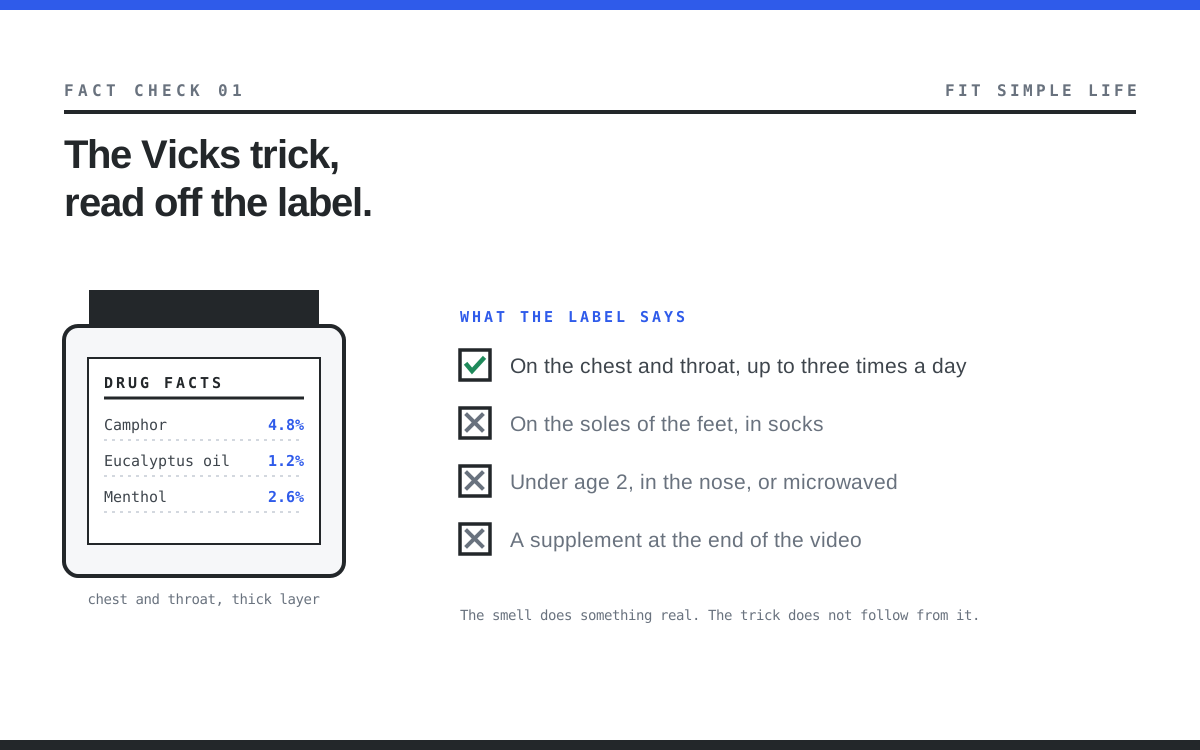
The short answer: a jar of Vicks VapoRub does one modest, well-documented thing, and the viral “trick” videos ask it to do several things it has never been labeled for. The smell is real. The foot-and-sock mechanism is not. And the versions that end with a doctor-style narrator and an order form are selling something that is not in the jar at all. Here is the jar read off its own Drug Facts panel, with the research kept in proportion and a stuffy-night routine at the end.
What the videos actually say
There are a few versions, and they share a shape. The oldest is the sock one: rub the ointment on the soles of your feet, pull socks on, go to bed, and wake up with the cough gone, sometimes with a side promise of calm and deeper sleep. The explanation offered is that nerve endings in the sole signal the brainstem. McGill University’s Office for Science and Society traced that mechanism to one practitioner’s social-media video and found no proper trial of it; what exists is anecdote.
The newer version arrives as a paid ad. A narrator who looks and sounds like a familiar television doctor explains a “hidden” way to use the ointment for breathing or mucus, often with a kitchen ingredient thrown in. The jar is the hook. Several minutes later the real product appears: a spray or a capsule, sold in multi-bottle bundles. The Federal Trade Commission’s consumer alert on this pattern is blunt: scammers are using fake celebrity and influencer testimonials “complete with doctored video and audio that seems like the real thing.” Its advice: search the person’s name with the product and the word “scam,” and ask a health professional before buying any supplement, since supplements are not reviewed before sale.
Other versions promise other benefits to other audiences. The structure is identical, and so is the answer: check the jar against its own label.
What is actually in the jar
We read the Original ointment’s Drug Facts panel on DailyMed, the National Library of Medicine’s label archive, on October 7, 2026, and checked it against the manufacturer’s page the same day. Three active ingredients, all labeled as cough suppressants, two also as topical pain relievers for minor muscle and joint aches, in a petrolatum base with a few more aromatic oils.
| Active ingredient | Amount | What to know |
|---|---|---|
| Camphor (synthetic) | 4.8% | Cough suppressant and topical analgesic. The FDA monograph sets ointment camphor at 4.7 to 5.3 percent; the lemon and lavender scents list 4.7. |
| Eucalyptus oil | 1.2% | Cough suppressant. The strong, familiar part of the smell. |
| Menthol | 2.6% | Cough suppressant and topical analgesic. The monograph range for ointments is 2.6 to 2.8 percent; this jar sits at the bottom of it. |
| Inactive | — | Cedarleaf oil, nutmeg oil, petrolatum, thymol, turpentine oil (the scented versions add fragrance). |
These are not arbitrary numbers. Camphor and menthol are the only two topical cough suppressants the FDA’s over-the-counter cough monograph lists, and the same rule fixes their strengths and the wording of the directions. The jar has one narrow, regulated job: when vapors from the chest and throat reach the nose and mouth, it “temporarily relieves cough due to minor throat and bronchial irritation associated with the common cold.” That sentence is the label’s, not ours, and it is the whole claim.
What the label allows, and what it rules out
The directions fit in two sentences. Adults and children 2 years and over: rub a thick layer on the throat and chest, cover with a warm, dry cloth if you like, keep clothing loose so the vapors can reach the nose and mouth, up to three times a day. For minor muscle and joint aches, apply to the affected area no more than three or four times a day. The warnings are longer, and they are the part the videos leave out.
- Not under 2. The manufacturer’s label says “children under 2 years: do not use.” (The federal monograph wording is “ask a doctor”; the brand went stricter.)
- Not by mouth, not in the nostrils, not on wounds or damaged skin, not under tight bandages. “For external use only; avoid contact with eyes” is the first line of the warnings.
- Never heated. Do not heat, microwave, or add it to hot water or any container where water is being heated: “may cause splattering and result in burns.”
- Stop and ask a doctor if a cough lasts more than a week, keeps coming back, or arrives with fever, rash or a persistent headache; ask before use if you are pregnant or breast-feeding.
Each line has a reason behind it. Poison Control’s write-up describes a woman who warmed the ointment in a glass bowl in a microwave; it exploded in her face and she needed extensive eye surgery. Swallowed, the problem is the camphor: U.S. poison centers logged roughly 10,000 ingestion exposures a year to camphor-containing products across 1990 to 2003, and camphorated oil, an older and stronger product, sits on the FDA’s list of drugs withdrawn for safety. The not-in-the-nose rule has a published case behind it: a 2009 paper in Chest opened with a toddler in severe breathing distress after the ointment was put directly under her nose, and the authors’ work in ferret airways found mucus secretion up about 63 percent and the beating of the airway’s clearing cilia down about 35 percent (mucus did move faster along airways the team had first inflamed). A ferret is not a child, but it is a reason to keep the stuff where the label puts it.
What the research says about menthol
Feeling versus plumbing. Menthol acts on a cold-sensing receptor on sensory nerves; when vapor reaches the nose, that receptor fires and breathing feels cooler and freer. A 2003 review from Cardiff University’s Common Cold Centre frames menthol’s long use for a stuffy nose in exactly those terms: its effects on the sensation of nasal airflow and the drive to breathe. That is a genuine effect, and a sensory one: a change in how breathing feels, not in what the airway is doing.
The cough reflex. Two small lab studies in healthy adults point the same way: in 1994, twenty volunteers who inhaled menthol in eucalyptus oil before a citric-acid cough challenge coughed less than after pine oil or plain air, and in 2012 twelve healthy non-smokers who inhaled menthol vapor had their cough threshold in a capsaicin challenge raised by about a quarter. Both are provoked-cough models in people who were not ill, so they show the reflex can be quieted for a while, not that an illness gets shorter.
The one trial of the actual product. A 2010 study in Pediatrics gave 138 children aged 2 to 11 with a cold one bedtime application of the vapor rub, plain petrolatum, or nothing, on the chest and neck, and had parents rate the night. The rub scored best for cough, congestion and sleep difficulty; petrolatum was no better than nothing. Three limits: the no-treatment group could not be blinded (parents in the other two groups dabbed vapor rub under their own nose first so the smell would not give the jar away), irritant side effects were common in the rub group (46 percent reported at least one, mostly a burning feeling on the skin, eyes or nose), and the study was paid for by an unrestricted grant from the manufacturer. One night, parents’ ratings, the product used as labeled.
Three findings, one shape: when vapors reach the nose, breathing feels easier and the urge to cough is quieter for a while. That is why the label says chest and throat with the collar loose, and why none of it transfers to the soles of your feet or to a capsule.
Why the trick claims do not follow
The feet. The soles are the farthest point on the body from the nose, and socks are there precisely to keep the vapor in. The proposed foot-to-brainstem nerve pathway has no trial behind it; McGill’s science office found none, and neither did we. If someone sleeps better after trying it, the honest candidates are the open jar scenting a small room, or a fixed bedtime ritual working as a sleep cue. For an adult with intact skin it is probably harmless and plainly off-label. For a child under 2 the answer is no, wherever you put it.
The breathing version. Nothing on the label mentions the airways, clearing mucus, or anything inside the body; it is an external ointment whose only labeled respiratory effect is a temporary quieting of cough. The “hidden method” is a loss leader for a supplement with its own un-reviewed claims. The narrator’s face is borrowed, the tip is a prop, and the product on the order form is unrelated to the jar.
One test covers every version: if a video about a jar ends on an order form for something that is not in the jar, the trick was the video.
A stuffy-night routine: five steps
A sequence for a healthy adult with a head cold, not a promise about how the cold goes. The jar is optional.
Decide about training first daytime
Use the “neck check” sports-medicine clinics describe: symptoms all above the neck, a runny or blocked nose and not much else, make a lighter session reasonable, with the effort cut by about half. Fever, chest tightness, trouble breathing, muscle aches or stomach symptoms mean rest and a word with a clinician. A missed session is not a failed week.
Warm shower, then the rub as labeled, or skip it before bed
If you use the ointment: adults and children 2 and over, a thick layer on the throat and chest, collar loose, nowhere near the nose or eyes, nothing heated, hands washed afterward. If you would rather not, nothing else here depends on it.
Set the room 5 min
Cool, quiet, dark, with a glass of water on the nightstand. The CDC’s sleep habits apply doubly on a stuffy night: no large meal or alcohol close to bedtime, no caffeine in the afternoon or evening.
Devices off, lights out early 30 min before
Screens off at least half an hour before bed, and in bed early enough for the seven or more hours the American Academy of Sleep Medicine and the Sleep Research Society recommend for adults. A cold is a night to add an hour, not to catch up on a show.
Morning check next day
Run step 1 again, and keep the label’s own stop line in view: a cough that has run more than a week, keeps returning, or arrives with fever, rash or a persistent headache is the label’s cue to see a doctor, not to try a new trick.
If you want a jar
There is nothing wrong with owning one for the use on the label. On October 7, 2026 a three-pack of Original 1.76 oz jars was $22.41 on Amazon ($4.24 an ounce), in stock, shipped and sold by Amazon.com, and marked non-returnable for food-safety reasons, so settle on the size before ordering. The single 3.53 oz jar was $10.97 the same day but was offered only through AmazonFresh, Amazon’s grocery delivery service, which depends on your address. The listing’s Drug Facts matched the label we read. Two things to check: the lemon and lavender scents list camphor at 4.7 percent rather than 4.8, and the children’s version has its own label (the same three actives, the same not-under-2 rule), which is the one to read for a child.
As an Amazon Associate we earn from qualifying purchases. Affiliate disclosure
This routine assumes a healthy adult with an ordinary head cold. If you have an existing condition, take medication, are pregnant or breast-feeding, or are thinking about using any vapor rub on a child, ask a clinician or pharmacist first and read the product’s own label, not a video. Stop if the skin burns, reddens or breaks out; never put it in the nose, mouth, eyes or a microwave. Nothing here diagnoses anything; a cough that is getting worse, or comes with shortness of breath, is a question for a clinician today, not for a sock.
Sources
- DailyMed (U.S. National Library of Medicine). Vicks VapoRub Original ointment: Drug Facts panel, current label version. Accessed October 7, 2026. link
- Vicks (Procter & Gamble). VapoRub product page: active ingredients, uses, directions and warnings. Accessed October 7, 2026. link
- U.S. Food and Drug Administration. 21 CFR 341.74, labeling of antitussive drug products: permitted topical ingredients, strengths and directions. eCFR, current. link
- U.S. Food and Drug Administration. 21 CFR 216.24, drug products withdrawn or removed from the market for reasons of safety or effectiveness (includes camphorated oil). eCFR, current. link
- Poison Control (National Capital Poison Center). Is Vicks VapoRub safe? Case reports on ingestion, over-application and microwave heating. link
- American Association of Poison Control Centers. Evidence-based practice guideline for out-of-hospital management of camphor poisoning. Clinical Toxicology, 2006. link
- Wake Forest University School of Medicine authors. Vapor rub, mucin secretion and ciliary beat frequency in the ferret trachea, with the toddler case that prompted the study. Chest, 2009. link
- Cardiff University Common Cold and Nasal Research Centre. Review of menthol’s effects on the nasal sensation of airflow and the drive to breathe. Current Allergy and Asthma Reports, 2003. link
- Royal Hallamshire Hospital, Sheffield, authors. Inhaled menthol and citric-acid-induced cough in 20 healthy subjects. Thorax, 1994. link
- Monell Chemical Senses Center authors. Sweet taste and menthol raise cough reflex thresholds in a capsaicin challenge. Pulmonary Pharmacology & Therapeutics, 2012. link
- Penn State College of Medicine authors. Vapor rub, petrolatum, and no treatment for 138 children with nighttime cough and cold symptoms. Pediatrics, 2010. link
- McGill University, Office for Science and Society. The rub on Vicks VapoRub: the feet-and-socks claim and its origin. March 2025. link
- Federal Trade Commission, Consumer Advice. Consumer alert on fake celebrity and influencer testimonials using doctored video and audio. April 2024. link
- Cleveland Clinic. Should you work out when you are sick? The “neck check” and when to rest. link
- Centers for Disease Control and Prevention. About sleep: how much adults need and habits for better sleep. Reviewed May 2024. link
- American Academy of Sleep Medicine and Sleep Research Society. Joint consensus statement on the recommended amount of sleep for a healthy adult. Sleep, 2015. link
This article is educational and is not medical advice. Vicks VapoRub is an over-the-counter drug; use it only as its label directs. Ask a qualified clinician before starting a new exercise or nutrition routine, especially if you have an existing condition or take medication.